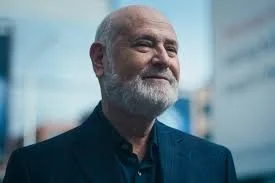
From Meathead to Movie-Making Icon: Exploring the Brilliance of Rob Reiner
“Everybody talks about wanting to change things and help and fix, but ultimately, all you can do is fix yourself. And that's a lot. Because if you can fix yourself, it has a ripple effect.”
Rob Reiner, celebrated filmmaker, writer, director, producer, actor, and philanthropist, tragically died on Sunday, December 14th, 2025. This isn’t about the tragedy of his death, but rather an exploration of his genius and art. That said, please make sure you take care of your mental health.
Reiner first appeared on the media landscape as an actor playing Mike "Meathead" Stivic on the CBS sitcom All in the Family from 1971 to 1979, a role that earned him two Primetime Emmy Awards. Meathead was the husband of Gloria Bunker, a college-educated progressive “hippy”, who served as a foil to Carroll O’ Connor’s bigoted boomer, Archie Bunker. While many viewers related to the main character of Archie Bunker, the actual point of the show was that Bunker was a dinosaur. An antiquated relic of a time (that should have) since passed. His bigoted views were presented perfectly by O’ Connor and contrasted artistically by Norman Lear’s sharp writing and Reiner’s deft performances.
Fifty years later, it’s clear we missed the point.
What’s fascinating about Reiner is how his real life reflected the social progressivism of his first character. Reiner spent his life fighting for progressive causes and vocally espousing socially liberal views, as Meathead did on All in the Family.
For many Gen Xers, Meathead was the first liberal icon represented on television. He served as a template for later characters like Hawkey Pierce on MASH, Steven and Elyse Keaton on Family Ties, and Leslie Knope on Parks and Rec. But Meathead was first. And what a liberal icon he was. A first-generation college graduate with a degree in sociology, who would later earn him a faculty position teaching at the University of California. He was an anti-war Polish-American who believed in women’s rights, the right to protest that which we disagreed with, freedom of speech, and more. He was for gun legislation. His vocal progressivism contrasted sharply with Bunker’s blue-collar conservatism. For young people, we saw in Mike Sativic, opportunity. We saw a path to a brighter future. We didn’t have to work in blue-collar jobs after high school. Not that those jobs aren’t important and require exceptional skillsets to perform, but some wanted something different-intellectual pursuits that led to liberal arts educations. We wanted our neighborhoods, communities, country, and world to be better, safer, inclusive, and welcoming. My dad worked in a factory and was miserable. He worked his ass off and told me that education should be my top priority. He was far from a progressive liberal, but he wanted something different for me.
After playing Meathead, Reiner became better known as a filmmaker, and a brilliant one at that. His directorial debut, This is Spinal Tap, is a “rockumentary” following a fictional rock band at the beginning of their decline. Reiner also starred in the film as the documentary's director. It was all very meta and set the stage for the style for years, eventually being perfected on TV by The Office.
Next came Reiner’s first Stephen King collaboration, the coming-of-age drama Stand By Me. It was a brilliant film and set up Reiner for his masterpiece with his next King adaptation, 1990’s Misery.
What’s that you say? The Princess Bride is his masterpiece? Well, of course it is. One of the most beloved and quoted movies of all time, The Princess Bride solidified his comedy chops and created an unbelievably popular movie that would be beloved by generations to come.
Reiner also gave us one of the most 80’s movies ever, the template for romantic comedies, When Harry Met Sally, another film that saw Reiner dusting off his comedic acting chops as well.
Reiner dominated the 1990’s with two powerhouse films that touched on politics, but showcased Reiner as a master craftsman: A Few Good Men and The American President. These films showed that Reiner could absolutely get the best acting out of the best actors. He coaxed extraordinary performances out of a young Tom Cruise and a veteran Jack Nicholson in A Few Good Men. He did the same with Michael Douglass and Annette Benning in The American President.
The American President, written by Aaron Sorkin, was sort of a prequel to The West Wing. Many of the tropes established here would be seen in the landmark NBC TV drama, but importantly, the film gave us an ideal for the president of the United States. Michael Douglas’ Andrew Shepherd, a widowed democrat and socially progressive president with a 63 percent approval rating, was a sight to behold. He was someone to look up to. He made the hard decisions and always fought for what’s right for all Americans. It’s an ideal that sets liberals apart from conservatives. Conservatives only want what’s best for themselves. Liberals want what’s best for everyone. It’s an idea that is central to my belief system and personality, and why I relate closely to Reiner.
Most recently, Reiner appeared on The Bear, one of my favorite TV series ever, and released a long-awaited sequel to This is Spinal Tap.
Outside of filmmaking, Reiner was very vocal about his beliefs. He spoke freely about what was right and used his voice to criticize what was wrong. He was a co-founder of the American Foundation for Equal Rights, and worked to pass important legislation in California. It’s this outspoken nature that made Reiner a target of the right. Sitting President Donald Trump called him “bad for our country” and a “deranged person.” Which is rich coming from the worst president in history. Trump is the antithesis of the aforementioned Andrew Shepherd. He’s a vile person who has used the presidency to enrich himself and his family while allowing tech oligarchs and religious fanatics to dismantle our nation. Reiner’s loss comes at a heavy time, and his voice, an influential liberal voice, will be difficult to replace. We still have his films which all hold up and we have his legacy and ideals. It’s now our job to carry on his legacy.